Project Ailouros
Project Ailouros
It all started late one quiet night, watching my cat freeze in the corner of the room. For nearly twenty minutes, he didn’t blink once, just intensely stared at a completely blank spot on the ceiling.
If you have a cat, you know that exact moment. You look at them and silently wonder: “what on earth is going on in that little head of yours?”
That tiny spark of curiosity eventually led to an idea that sounds straight out of a sci-fi novel, yet is surprisingly grounded in modern science: What if we could genuinely hear our cats’ thoughts, word for word?
Here’s the story behind the idea, how the tech actually works, and why it could completely change our relationship with our feline companions.
Why Do We Even Need This?
Humans and cats have lived together for thousands of years, and we like to think we understand them through every meow and tail flick. But here’s a fun fact: in the wild, adult cats almost never meow at each other. That adorable “meow” is essentially an evolutionary cheat code a specialized sound they developed just to get our attention.
In short, what we hear is just the tip of the iceberg. It barely scratches the surface of what they’re actually experiencing.
Beyond everyday curiosity, there’s a much more urgent reason behind this project: cats are absolute masters at hiding their pain.
Because they’re both predators and prey in nature, their ancient instincts scream at them never to show weakness. Many cat owners only discover a chronic illness like kidney failure or severe arthritis when it’s already dangerously late. They simply endure the pain in quiet isolation.
That heartbreak is why Project Ailouros came to life. We don’t want to guess from their meows anymore; we want a direct line to the source: their mind.
How Does It Actually Work?
Before your imagination runs wild with images of gruesome brain surgery and sci-fi wires, don’t worry modern neurotechnology has found a far gentler, minimally invasive way.
Here’s the breakdown in four simple steps:
1. The Covert “Neural Microphone”
Instead of drilling into the skull, the setup relies on an endovascular stentrode. Think of it like a heart stent procedure for humans: a flexible micro-mesh is guided gently through a tiny blood vessel in the neck. It comes to rest safely inside a blood vessel sitting right on the surface of the brain.
From inside that vessel, the sensor picks up clear neural electrical signals without touching or damaging delicate brain tissue at all. The cat won’t even feel it’s there.
2. Decoding a Language Without Words
Cats don’t think in English, grammar, or structured sentences. Their thoughts are a raw symphony of sensory inputs, spatial math, and instincts firing all at once.
Take a classic scenario: your cat spots a gecko high up on the wall. Inside their brain:
- Visual cortex: Locks onto the rapid silhouette.
- Hippocampus (internal GPS): Instantly calculates distance: “Ten feet up, completely out of leaping range.”
- Limbic system (emotions): An electric mix of hunting excitement and pure frustration.
- Motor neurons: Tensing the hind legs to spring, yet held back by the distance calculation.
3. AI as the “Vibe & Intent” Translator
These simultaneous neural bursts form a unique electrical signature. A tiny, lightweight transmitter on their collar beams this data wirelessly to a local processor.
This is where AI steps in. It’s trained not to listen for sounds, but to interpret these distinct neural patterns. Like an exceptionally intuitive translator, the AI synthesizes the cat’s visual focus, spatial reality, and emotional state into coherent human speech.
4. A Voice in Your Ear
In a split second—faster than the blink of an eye the translation streams straight into your wireless earbuds:
“There’s prey up there, but I can’t reach it. Hey, can you help me out?”
What Changes for Us and Them?
Hearing our cats’ casual banter sounds undeniably fun, but the real-world impact runs much deeper than just novelty:
- Saving Lives at the Vet:
Picture bringing a lethargic cat into the clinic. Instead of stressful trial-and-error tests, your cat can directly communicate the issue: “My lower belly has been burning since yesterday.” Subtle, life-threatening conditions could be treated weeks before they become critical. - Decoding Hidden Anxiety and Trauma:
Ever had a cat suddenly panic, scratch furniture, or stop using the litter box out of nowhere? We often label it as “bad behavior,” when they might actually be distressed by a high-frequency noise we can’t hear or a smell they perceive as dangerous. We can finally understand their stressors and build a home where they truly feel safe. - A Genuine Two-Way Relationship:
The dynamic shifts from a passive pet to a true companion with their own preferences and boundaries. We’ll know when they genuinely want affection, and when they just want to be left alone in their favorite cardboard box.
Concept Preview
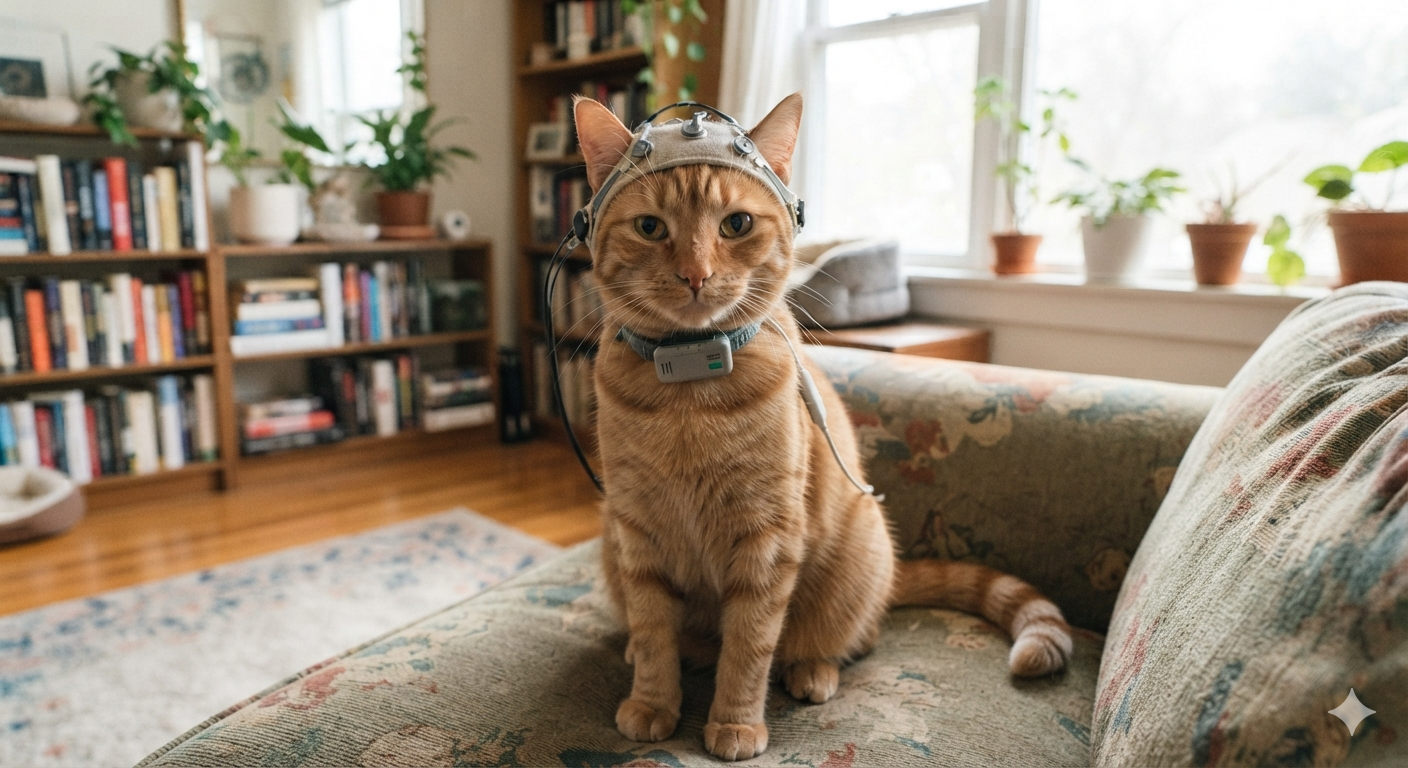
AI-generated content
Wrapping Up
A lack of human speech doesn’t mean a lack of rich inner thought. For centuries, a cat’s consciousness has been quietly locked behind biological limitations deep feelings and sharp minds, simply lacking the vocal cords to say the words.
Neurotechnology might just be the bridge that closes that gap.
Maybe one day, as you sit side by side on the porch watching the sunset, your cat won’t just stare quietly into the distance. Through a gentle whisper in your ear, you’ll finally hear what they’ve felt all along:
“I like sitting here with you. It’s really peaceful tonight.”